Integrated Village Development Project - Mokhada, Maharashtra

Integrated Village Development Project - Mokhada, Maharashtra

Implemented through a tripartite partnership with JM Financial Foundation and the Palghar District Administration, the IVDP initiative addresses the diverse challenges faced in Mokhada-a tribal, rain-fed agricultural region of Palghar District, Maharashtra. The project focuses on resolving critical issues such as inadequate irrigation, unsustainable farming practices, seasonal migration, and limited access to government schemes.

  • 560 acres of barren land were restored to productive use, supported by 16.81 crore liters of annual water savings and reduced land degradation.
  • Watershed interventions—including 13,178 CCTs and 417 farm ponds—helped conserve 1,154 lakh liters of water, improved soil stability, and raised water levels in 56 wells.
  • Renewable and efficient irrigation solutions such as solar lift systems and 98 drip irrigation units saved 11,282 electricity units, 4,513 liters of diesel, and 4.2 crore liters of water annually.
  • Plantation of 39,973 saplings improved carbon sequestration and soil fertility; climate-smart agriculture practices (SRI, pulses, indigenous crops) enhanced yields and reduced 43.7 MT of carbon emissions.
  • Organic farming initiatives produced 424.55 tons of vermicompost and 53,641 liters of vermiwash, reducing chemical fertilizer use by 271.51 tons and saving farmers ₹49 lakh; 17,998 applications supported improved access to government schemes.
  • 560 acres of barren land converted into productive use, stopping degradation
  • Annual saving of total 16.81 cr. (168.1 million) liters of water through various structures & storage.
  • Saving of app. 11,282 (units) of electricity and 4,513 liters of diesel.
  • Reduction in use of 271.51 tons of chemical fertilizer.
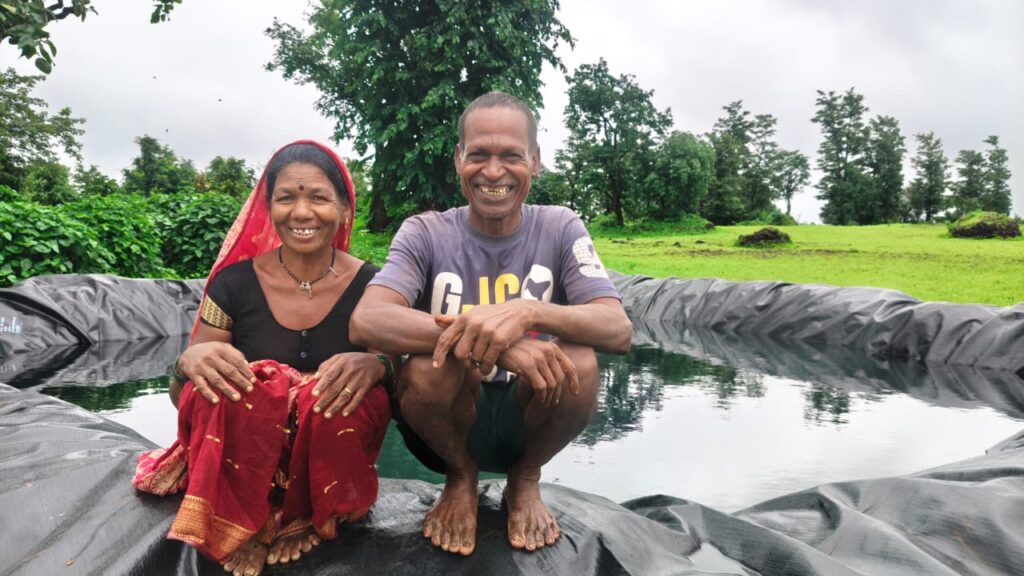
  • Watershed Management: Implementation of 13,178 Continuous Contour Trenches (CCTs) across 229.25 acres has conserved 823.36 lakh liters of water and prevented the erosion of 1.1 metric tons of topsoil. These efforts have raised water levels in 56 wells by an average of two feet, extending water availability by 20–30 days, and reduced seasonal migration. Farm ponds (417) store 330.7 lakh liters of water, enabling year-round farming and horticulture.
  • Renewable Energy and Sustainable Irrigation: Six 3.5 HP solar lift irrigation systems irrigate 11 acres, reducing dependency on fossil fuels and saving 11,282 units of electricity and 4,513 liters of diesel annually. Additionally, 98 drip irrigation systems covering 14 acres save 4.2 crore liters of water annually compared to conventional methods.
  • Reversing Land Degradation and Carbon Sequestration: A total of 39,973 agroforestry and horticulture saplings have been planted, converting 560 acres of barren land into productive use. Each tree sequesters 0.8 kg of carbon annually, significantly contributing to carbon capture and improved soil fertility.
  • Sustainable Agriculture and Climate-Resilient Crops: The Adoption of the System of Rice Intensification (SRI) by 763 farmers has increased paddy yield by 30–40%, while line transplantation techniques in 82 acres have enhanced yield by 45%. Cultivation of pulses (chickpea and pigeon pea) on 337.25 acres has improved nitrogen fixation, saving ₹1.15 lakh in fertilizer costs and reducing greenhouse gas emissions by 43.7 metric tons. The promotion of indigenous crops like blue rice and millet has improved climate resilience and food security.
  • Organic and Regenerative Farming: The use of 424.55 tons of vermicompost and 53,641 liters of vermiwash has enhanced soil health, reduced water pollution, and minimized air contamination. Organic farming adoption has resulted in savings of ₹49 lakh in fertilizer costs while ensuring sustainable agricultural productivity.
  • Socio-Economic Impact and Convergence: IVDP has strengthened access to government schemes by processing 17,998 applications, with 96.9% successfully submitted and 79.1% beneficiaries receiving entitlements worth ₹1305 lakh. Capacity-building initiatives have trained 4,601 farmers and 1,854 Self-Help Group (SHG) members, fostering financial stability and self-reliance. The distribution of 550 water wheels has eased water collection, reducing the burden on women and improving household efficiency.